


0 Why Does My Yorkie Puppy Follow Me Everywhere?
- Valness Yorkies Blog
- by Kathy Pittman
- 09/26/2026
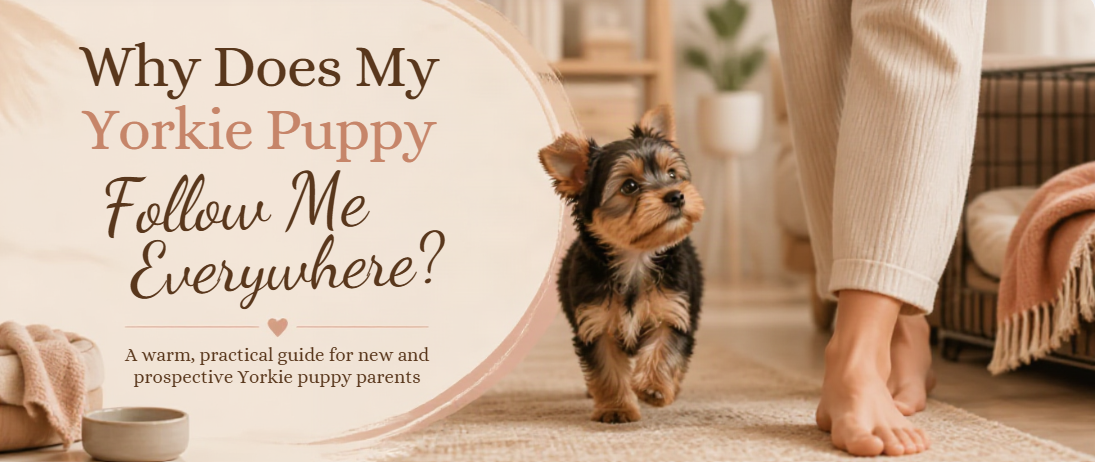
Why Does My Yorkie Puppy
Follow Me Everywhere?
Understanding attachment, “Velcro Yorkie” behavior, healthy independence, and when constant following deserves a closer look
|
QUICK ANSWER Most Yorkie puppies follow their people because they are social, curious, learning the household routine, and feel safest near the people caring for them. In many puppies, this is normal. The goal is not to stop affection - it is to pair closeness with confidence, rest, and short periods of comfortable independence. |
If your Yorkie puppy seems to be your tiny shadow - following you from the kitchen to the bathroom and back again - you are seeing a behavior many Yorkie families recognize. Yorkshire Terriers were bred to be alert, engaged little dogs, and modern Yorkies often form close relationships with their people.
Following is usually a mixture of attachment, curiosity, routine, learning, and reinforcement. A puppy may simply be thinking, “Where are we going next?” The important question is not whether your puppy follows you, but whether your puppy can also settle, rest, eat, play, and feel safe when you are not within arm’s reach.
1. Why Yorkie Puppies Become Little Shadows
A young puppy has just left a familiar environment and is learning an entirely new home. You are the source of food, warmth, play, bathroom trips, comfort, and information about what is safe. Staying close is a very efficient puppy strategy.
Attachment: your puppy is learning who provides safety and care.
Curiosity: puppies want to know what you are doing and whether something interesting is about to happen.
Routine: if following you often leads to food, play, outside time, or cuddles, the pattern quickly becomes meaningful.
Learning: puppies study household movement and copy what gets rewarded.
Temperament: some Yorkies are naturally more people-focused than others.
|
VALNESS PUPPY PARENT TIP Enjoy the affection, but begin teaching “I can relax here while you move around” from the first week. Independence is easiest to build in tiny, positive steps. |
2. Is This the Famous “Velcro Yorkie” Personality?
People sometimes call a very people-oriented dog a “Velcro dog.” The nickname can be cute, but it is not a diagnosis. Some perfectly healthy Yorkies simply prefer being near their family. A social puppy who follows you and then settles on a bed, plays independently, naps in a crate, or calmly stays with another trusted person is usually showing attachment rather than distress.
Healthy attachment and separation-related distress can look similar at first glance, so it helps to watch what happens when you actually create a little distance.
Often Normal Attachment |
Worth a Closer Look |
|
Follows you from room to room, then settles nearby. |
Cannot settle unless touching or seeing you. |
|
Accepts a chew, toy, nap, or food while you move around. |
Stops eating or panics when you step away. |
|
Can rest in a crate, pen, or dog bed for short periods. |
Frantic scratching, escape attempts, nonstop vocalizing, or drooling when separated. |
|
Greets you happily after a short absence. |
Extreme distress begins as you prepare to leave or immediately after you go. |
3. Your Puppy May Have Accidentally Trained You
Yorkies are observant. If following you produces eye contact, conversation, treats, pickup time, or a game every single time, the behavior can become stronger simply because it works. That does not mean you should ignore your puppy. It means you can deliberately reward other behaviors too.
Reward your puppy for relaxing on a mat or bed while you are nearby.
Sometimes walk from one room to another without turning the trip into an event.
Give attention when your puppy is calm, not only when they are demanding it.
Offer safe independent activities such as an age-appropriate food toy or supervised chew.
4. Teach “Near Me” and “Not On Me”
A confident companion dog can enjoy closeness without needing constant physical contact. Try creating small “parking spots” around the home - a bed, mat, crate, or exercise pen where your puppy can rest while family life continues nearby.
|
A SIMPLE 5-MINUTE CONFIDENCE GAME Place your puppy on a comfortable mat with a safe toy or chew. Sit nearby. Reward calm behavior. Stand up, take one step away, return, and reward calmness. Over several sessions, gradually add distance and a few seconds of time. Keep the exercise easy enough that your puppy succeeds. |
5. Short Separations Should Be Boring and Safe
Independence training does not mean leaving a young puppy alone for long stretches. Start with seconds or a few minutes while you are still home. A secure crate or puppy pen can help prevent unsafe wandering while your puppy learns that people can move in and out of sight and still come back.
Try not to make every departure or return highly emotional. Calm routines help many puppies understand that separations are a normal part of the day.
6. Following Can Increase During the First Days Home
A newly arrived puppy may follow more closely during the first days or weeks because everything is unfamiliar. That can be especially noticeable after a big change in routine, a move, a new family member, travel, or a stressful event. As the puppy learns the household rhythm and builds confidence, the intensity often changes.
Very young puppies also need frequent potty trips, meals, naps, and supervision, so owners are naturally near them much of the time. That closeness can be both necessary and temporary.
7. How to Build Healthy Independence Without Pushing Your Puppy Away
Practice |
What It Looks Like |
|
Start with rest |
Reward calm naps in a crate, pen, bed, or mat. |
|
Use tiny absences |
Step out of sight briefly and return before your puppy becomes overwhelmed. |
|
Let other trusted people help |
Have another household member offer a meal, short play session, or calm cuddle. |
|
Practice when you are home |
Do not make independence something that happens only when everyone leaves. |
|
Keep needs met |
A puppy who is hungry, overtired, cold, needs to potty, or is under-stimulated will have a harder time settling. |
|
Build gradually |
Increase time and distance only when your puppy remains comfortable. |
8. Make Sure Following Is Not Replacing Sleep
Puppies need a great deal of sleep. A puppy who follows every footstep may stay awake longer than is helpful, especially in a busy household. An overtired puppy can become mouthy, frantic, clingy, or unable to settle - which can look like “more attachment” when the real need is rest.
|
REST COUNTS AS TRAINING A puppy who can nap safely while normal household life continues is practicing an important life skill: settling without needing to participate in every movement. |
9. What About Separation Anxiety?
Following you everywhere by itself does not prove separation anxiety. Separation-related problems are about distress when access to the person is reduced or the person leaves. Warning signs can include panic, persistent vocalizing, frantic escape behavior, destructive attempts around exits, drooling or panting that is out of proportion to the situation, house-soiling despite otherwise appropriate training, or inability to eat or settle when alone.
If you see severe or escalating distress, avoid simply letting a puppy “cry it out” for long periods. Speak with your veterinarian and, when needed, a qualified reward-based trainer or veterinary behavior professional. Early help is usually easier than waiting for a pattern to become deeply established.
10. Sudden Clinginess Can Sometimes Be a Health Clue
A puppy who has always been comfortable alone and suddenly becomes unusually clingy may be seeking comfort because something feels wrong. Watch for other changes such as reduced appetite, vomiting, diarrhea, trembling, weakness, limping, coughing, unusual sleepiness, pain, or a change in bathroom habits.
Because tiny puppies can become weak or dehydrated quickly, contact your veterinarian promptly when sudden behavior change appears together with physical symptoms or when your puppy simply does not seem like themselves.
11. Can a Yorkie Bond With More Than One Person?
Yes. A puppy may initially shadow the person who feeds, trains, or spends the most time with them, but healthy family relationships can be broadened. Let other trusted household members participate in meals, training, grooming practice, play, potty trips, and quiet rest. The goal is not to weaken the primary bond - it is to help the puppy feel safe with more than one person.
12. A Balanced Day for a People-Loving Yorkie Puppy
Connection |
Confidence |
|
Cuddles and calm handling |
Short mat-settle sessions |
|
Training and play with you |
Age-appropriate solo toy or chew time |
|
Supervised exploration together |
Brief safe time in crate or pen while you are nearby |
|
Family socialization |
Time with another trusted caregiver |
|
Comfort after a new experience |
Plenty of uninterrupted naps |
Frequently Asked Questions
Will my Yorkie always follow me everywhere?
Maybe - some adult Yorkies remain very people-oriented. The important goal is not distance for its own sake, but the ability to relax and function comfortably when you are not right beside them.
Should I ignore my puppy when they follow me?
No. You can enjoy the companionship while also rewarding calm independence. The balance matters more than either constant attention or deliberate coldness.
Does letting my puppy sit on my lap create separation anxiety?
Affection does not automatically cause separation anxiety. The more useful approach is to pair affection with predictable practice settling in a crate, pen, bed, or mat.
Why does my puppy follow me into the bathroom?
Usually because your puppy is curious, attached, and has learned that where you go, interesting things may happen. It is common puppy behavior.
When should I ask for professional help?
If your puppy panics during brief separations, cannot eat or settle when alone, injures themselves trying to escape, or the behavior suddenly changes along with physical symptoms, contact your veterinarian and ask about behavior support.
The Goal Is Connection With Confidence
A Yorkie who wants to be near you is showing one of the qualities many families love about the breed. You do not need to discourage that bond. Instead, help your puppy learn two equally valuable lessons: “My people are safe and wonderful,” and “I can rest, play, and feel secure even when they are a few steps away.”
|
CONTINUE THE VALNESS YORKIES NEW PUPPY PARENT GUIDE Explore more practical puppy-care articles at ValnessYorkies.com, including Your Yorkie’s First Week Home, How to Crate Train a Yorkie Without Making the Crate Scary, |
Educational disclaimer: This article provides general puppy-care and behavior information and is not a substitute for veterinary diagnosis or individualized behavior treatment. Contact your veterinarian if behavior changes suddenly, your puppy shows physical symptoms, or separation causes severe distress.
